When a commercial property manager, school district administrator, or industrial facility owner begins exploring renewable heating solutions, the biomass boiler quickly emerges as one of the most compelling options available. Unlike fossil fuel systems that tie your operating budget to volatile global oil and gas markets, a biomass boiler harnesses locally sourced organic material to deliver consistent, carbon-neutral heat at a fraction of the long-term cost. But once you have decided that biomass is the right direction, a critical question remains: should you invest in a wood chip system or a wood pellet system?
The answer is rarely simple. Both fuel types power highly efficient biomass boiler installations, and both carry distinct advantages depending on the scale of your operation, your geographic location, and your internal resources. To cut through the marketing noise and make a genuinely informed decision, you need to evaluate the total cost of ownership (TCO) — a holistic metric that goes far beyond the sticker price of the equipment itself. In this article, we will break down the four pillars of TCO that matter most for commercial biomass boiler installations: fuel logistics, automation, maintenance, and reliability.
Understanding the Two Fuel Paths for Your Biomass Boiler
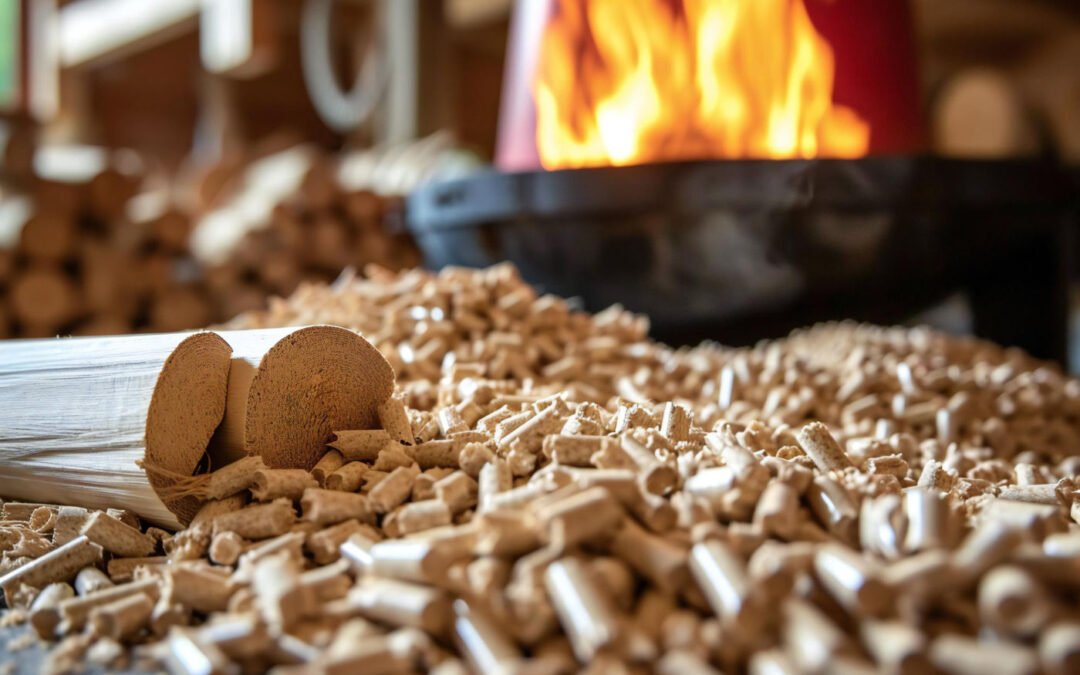
Before diving into cost comparisons, it is worth briefly clarifying what separates these two fuel types. Wood chips are produced by running whole trees, logging residues, or arboricultural waste through an industrial chipper. The resulting product is irregular in size, carries a moisture content that typically ranges from 25 to 55 percent, and is sold by the tonne at relatively low prices. Wood pellets, on the other hand, are a manufactured product. Sawdust and fine wood residues are dried, compressed under extreme pressure, and extruded into uniform cylindrical granules with a moisture content below 10 percent. This manufacturing process adds cost but delivers a fuel that is dense, consistent, and easy to handle.
Both fuels can be burned in a modern biomass boiler to produce hot water or steam for space heating, process heat, or domestic hot water. The differences lie in how each fuel behaves across the entire lifecycle of the system.
Fuel Logistics: Getting the Right Fuel to the Right Place at the Right Price
Fuel logistics often represent the single largest variable in the total cost of ownership for any biomass boiler installation, and this is where wood chips and pellets diverge most dramatically.
Wood chips are a bulk commodity. They are typically delivered in walking-floor trailers or tipper trucks, and a single delivery can fill a large commercial fuel store in a matter of minutes. Because chips require minimal processing, the per-tonne fuel cost is significantly lower than pellets — often 40 to 60 percent cheaper on a delivered-energy basis. For a large commercial site such as a hospital campus, university, or district heating network that consumes thousands of tonnes of fuel per year, this price differential can translate into tens of thousands of pounds in annual savings.
However, the lower fuel cost comes with logistical trade-offs. Wood chips require substantially more storage volume because of their lower energy density. A commercial biomass boiler running on chips may need a fuel bunker three to four times larger than an equivalent pellet system. The bunker itself must be engineered to handle the weight and flow characteristics of an irregular, sometimes damp material, which adds to capital expenditure. Additionally, chip quality can vary from load to load depending on the supplier, the species mix, and the season, which means your procurement team must be more vigilant about specifying moisture content and particle size.
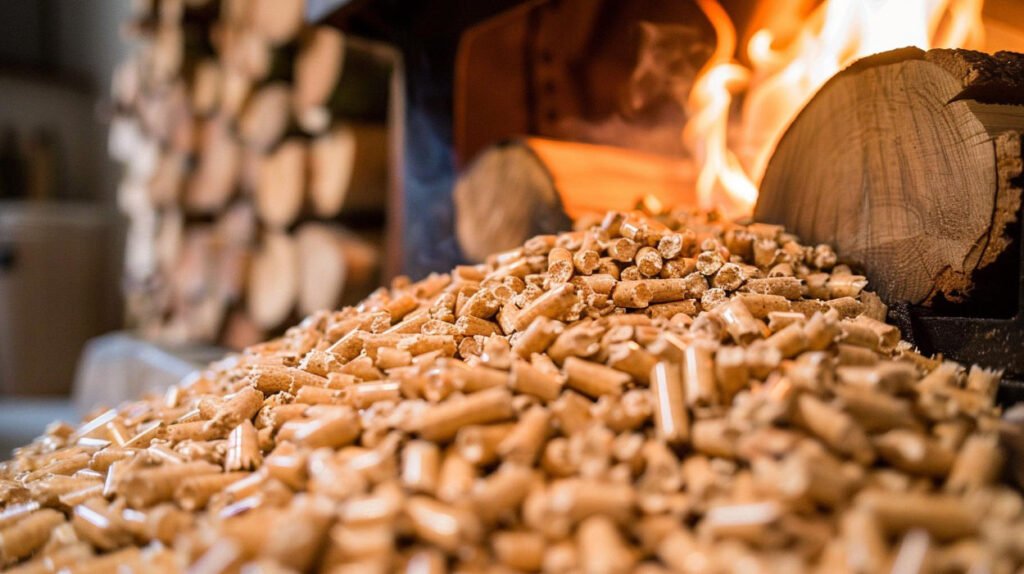
Wood pellets arrive in pressurized bulk tankers and are pneumatically blown into a silo, much like a heating oil delivery. The process is clean, fast, and requires very little on-site infrastructure beyond the silo and a few metres of fill pipe. Because pellets are energy-dense and uniform, storage footprints are compact — a significant advantage for commercial sites in urban areas or on constrained plots where a large chip bunker is simply not feasible.
The downside is cost. Pellets are a processed fuel, and you pay for that processing. Delivered pellet prices are higher per megawatt-hour of useful heat, and because the pellet market is more susceptible to international supply chain disruptions (a large share of European pellets are imported from North America and Eastern Europe), price volatility can be a concern. For a smaller commercial biomass boiler installation consuming a few hundred tonnes per year, the logistics savings and space efficiency of pellets often outweigh the higher fuel cost. For very large installations, however, the chip fuel cost advantage becomes difficult to ignore.
Automation: How Much Hands-On Management Does Your Biomass Boiler Require?
Modern biomass boiler systems are far more automated than the wood-burning equipment of previous decades, but the degree of automation still varies meaningfully between chip and pellet configurations.
A pellet-fed biomass boiler is the closest thing the industry offers to a “fit-and-forget” solution. The uniform size and flow characteristics of pellets allow them to be conveyed from the silo to the combustion chamber using simple auger systems with very few moving parts. Automated ignition, modulating burn control, and self-cleaning heat exchangers mean that a well-designed pellet system can run for weeks with minimal human intervention. For a commercial site that does not have a dedicated plant room operator — think small office blocks, care homes, or retail parks — this level of automation is a major advantage.
A wood chip biomass boiler can also be highly automated, but the engineering is more complex. Because chips are irregular and can bridge or rat-hole inside the fuel store, chip systems typically require live-floor bunkers, heavy-duty hydraulic rams, or rotating agitators to ensure a steady fuel flow to the combustion chamber. These mechanical systems add cost and complexity. Moisture variation in the fuel also means the boiler’s combustion management system must work harder to maintain optimal air-to-fuel ratios, which can affect efficiency if the control software is not sophisticated enough.
That said, for large commercial and industrial sites that already employ facilities management teams, the additional automation complexity of a chip system is rarely a dealbreaker. The staff are on-site anyway, and the fuel cost savings more than compensate for the slightly higher operational oversight.
Maintenance: Keeping Your Biomass Boiler in Peak Condition
Maintenance costs are the silent killer of many energy projects. A biomass boiler that looks affordable on day one can become a financial drain if it requires constant attention, expensive spare parts, or frequent shutdowns for cleaning.
Pellet systems generally demand less routine maintenance. The clean-burning nature of low-moisture pellets produces minimal ash — typically less than 1 percent of fuel mass — which means ash removal can often be handled by an automated auger into a small ash bin that needs emptying only a few times per heating season. Heat exchanger fouling is slower, and the uniform combustion profile puts less thermal stress on refractory linings and grate components.
Chip systems, by contrast, generate more ash due to the higher bark content and mineral impurities found in whole-tree chips. Ash removal systems must be more robust, and the ash bins need more frequent emptying. The higher moisture content of chips also means that more energy is consumed evaporating water inside the combustion chamber, which can lead to increased condensation and corrosion in the flue system if the boiler is not properly designed for the fuel. Grate mechanisms, which physically move the fuel bed through the combustion zone, experience more wear when processing abrasive, irregular chips compared to smooth pellets.
For a commercial biomass boiler installation, the practical implication is that chip systems typically carry 15 to 30 percent higher annual maintenance costs than pellet systems of equivalent output. This gap narrows at larger scales where maintenance contracts benefit from economies of scale, but it remains a factor that must be modelled into your TCO calculations.
Reliability: Uptime, Consistency, and Peace of Mind
Reliability is perhaps the most difficult factor to quantify but the most important to commercial operators who cannot afford heating interruptions. A school that loses heat in January or a food processing plant that cannot maintain steam pressure faces consequences far beyond the repair bill.
Pellet-fed biomass boiler systems tend to deliver higher year-round reliability because the fuel is so consistent. The boiler’s control system can be finely tuned to a known fuel specification, and the risk of feed blockages, bridging, or combustion instability is low. Downtime events are typically limited to scheduled maintenance windows.
Chip-fed systems are inherently more variable. A delivery of wet, oversized chips can cause feed problems, slagging in the combustion chamber, and temporary drops in efficiency until the fuel quality normalises. In practice, a well-designed chip system with adequate fuel storage (allowing the chips to season and stabilise) and a reputable fuel supply contract can achieve reliability figures very close to pellet systems. But the margin for error is smaller, and the consequences of poor fuel quality are more severe.
Total Cost of Ownership: Bringing It All Together
When you layer fuel costs, logistics infrastructure, automation complexity, maintenance budgets, and reliability risk across a 20-year project lifespan, a clear pattern emerges. For small to medium commercial sites (under 500 kW) with limited storage space and no dedicated plant room staff, a pellet biomass boiler typically delivers the lowest TCO despite the higher fuel price. The savings in capital infrastructure, reduced maintenance, and superior reliability offset the fuel premium.
For large commercial and industrial installations (above 1 MW) with ample land, on-site facilities teams, and access to a reliable local chip supply chain, a wood chip biomass boiler almost always wins on TCO. The fuel cost savings are simply too large to ignore, and the additional maintenance and logistics costs become proportionally smaller as the system scales up.
Making the Right Choice for Your Commercial Site
The decision between wood chip and pellet fuel for your biomass boiler should never be made on equipment price alone. Engage an experienced biomass engineering consultant to model your specific fuel supply options, site constraints, staffing capabilities, and heat demand profile. Request detailed TCO projections that span the full lifecycle of the system, including fuel price escalation scenarios, maintenance inflation, and potential carbon incentive revenues.
A well-specified biomass boiler — regardless of fuel type — can deliver decades of low-cost, low-carbon heating that insulates your commercial operation from fossil fuel price shocks and positions your organisation as a sustainability leader. The key is matching the right fuel to the right site, and letting the numbers, not the headlines, guide your investment.