
By Mark, Senior Biomass Engineer
In my twenty years in the heating trade, I’ve spent a lot of time in boiler rooms. I’ve seen the rise of gas condensing boilers, the dominance of oil in the countryside, and recently, the explosion of interest in air source heat pumps.
But if you drive me down a single-track lane in the Peak District, the Highlands, or the Cotswolds, and show me a 200-year-old stone farmhouse with flagstone floors and high ceilings, I’m going to tell you the same thing I told the last customer:
Heating of the Farmhouse: You don’t need a heat pump. You need fire.
There is a massive push in the UK right now to electrify everything. For a modern, airtight new build, that’s fantastic. But for the owners of traditional rural properties—the “hard-to-heat” homes—biomass isn’t just a nostalgic option. It is, technically and economically, the best engineering solution available.
Here is the honest truth, from an engineer’s perspective, on why wood power is the king of the countryside.
The Physics of the Stone House
To understand why biomass wins about heating of farmhouse , you have to understand the building.
Most pre-1919 UK homes were built to breathe. They have solid stone walls, no cavity, and often single glazing or heritage windows. They have high “thermal mass.” When these houses get cold, they stay cold.
If you try to heat a leaky, uninsulated stone farmhouse with a low-temperature system (like a heat pump running at 35°C–45°C), you are fighting a losing battle. The heat escapes faster than the system can put it in. To make it work, you have to turn the house into a thermos flask—internal wall insulation, underfloor heating, triple glazing.
That ruins the character of the building, and it costs a fortune.
Biomass boilers are different. A wood pellet or log boiler is a “high-temperature” heat source. It delivers water to your radiators at 70°C to 80°C—exactly the same as the oil or gas boiler you are replacing. It punches through the cold. It heats the thermal mass of the stone. It makes the house feel warm, not just “temperate.”
The “Retrofit” Headache (And How to Avoid It)
As an engineer, the biggest headache I see customers face is the disruption of installation.
If you switch an old farmhouse to a heat pump, you often have to rip out your existing radiators and replace them with units that are two or three times larger (to cope with the lower water temperature). You might even have to dig up those beautiful old flagstone floors to lay underfloor piping.
With a biomass boiler, the changeover happens almost entirely in the plant room or outbuilding.
-
- We keep your existing radiators.
- We keep your existing pipework.
- We keep your thermostat logic.
We simply strip out the dirty oil boiler or the expensive LPG tank, and we plumb in a modern biomass unit. The house doesn’t know the difference—until the bills come in.
The Economics: Beating the Oil Trap
For decades, rural UK homes have been held hostage by the price of heating oil (Kerosene) and LPG. You know the drill: you watch the geopolitical news, panic when prices spike, and try to time your delivery.
While wood pellet prices rose during the 2022 energy crisis, they have stabilized and are now extremely competitive.
But the real economic win is stability. Wood fuel is largely a local market. We have abundant forestry in the UK. By switching to biomass, you are decoupling your home from the volatile global oil markets.
Furthermore, the government knows that heat pumps don’t work everywhere. That is why the Boiler Upgrade Scheme (BUS) still offers a £5,000 grant for biomass boilers, specifically for rural properties where a heat pump isn’t feasible. They recognize that for a drafty farmhouse, biomass is the only renewable game in town.
It’s Not Like the Old Days (The Myth of Hard Labor)
When I mention “wood heating,” some clients picture a soot-covered Victorian stoking a furnace every hour.
Modern biomass engineering is a thing of beauty.
-
- Self-Cleaning: Premium boilers (like those from Austria or Scandinavia) clean their own heat exchangers.
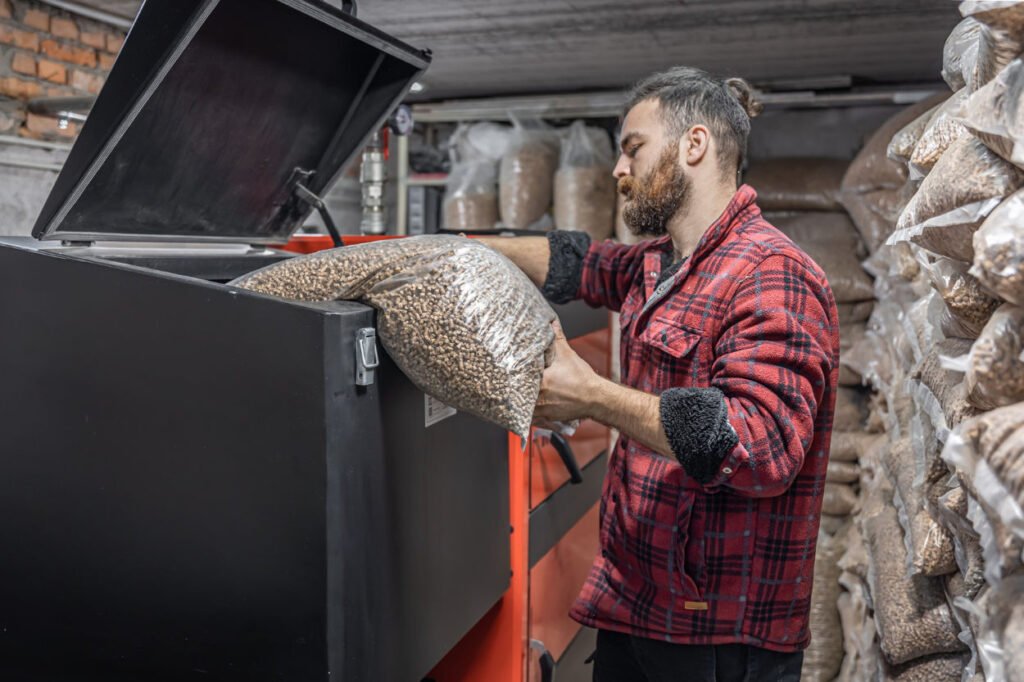
- Self-Loading: If you have the space for a bulk silo, a truck blows the pellets in once a year. A vacuum system sucks the pellets to the boiler automatically. You don’t touch the fuel.
- Ash Compression: You might empty the ash bin three or four times a year. That’s it.
I have installed systems for retired couples who want a “fit and forget” system. They get the reliability of gas, with the soul and heat of wood.
The Environmental Reality
Finally, let’s talk about carbon.
If you are running an oil boiler in a large detached farmhouse, your carbon footprint is enormous. You are burning fossil fuels that were dug out of the ground, adding new carbon to the atmosphere.
Biomass is part of the short-term carbon cycle. The tree absorbs CO2 as it grows; the boiler releases it when it burns. As long as the wood is sourced from sustainable forests (and BSL-authorized suppliers in the UK ensure this), you are effectively heating your home with trapped sunlight.
Heating Of Farmhouse: The Verdict
I install heat pumps, and I install biomass. I like them both.
But if you live in a new build with cavity walls and triple glazing? Get a heat pump.
However, if you live in a property with history—a barn conversion, a manor house, or a stone cottage exposed to the wind—don’t let anyone tell you that “fire” is outdated.
Biomass offers the high-grade heat these buildings were designed for, without the disruption of rebuilding your home, and without the carbon guilt of oil. It is robust, it is repairable, and on a freezing January night in the British countryside, it is simply the best way to keep the cold at bay.
